

Carbon Business Assessment 2024 update
Earthy Nail Polish in association with Tunley Engineering and Birmingham University publish our Carbon Business Assessment and the roadmap to net zero.
.jpg)
Introduction
The Business Carbon Assessment was completed to the international standard BS EN ISO 14064-1 and the GHG protocol. Quantification of carbon dioxide equivalent emissions arising from business activities and product processing are completed in accordance with emission factors of the Greenhouse gas reporting; conversion factors published by DEFRA (DESNZ), the UK Government Department for Energy Security and Net Zero for 2024.
Carbon equivalent data conversions were calculated in accordance with greenhouse gas reporting: 2024 published by the UK Government Department for Energy Security and Net Zero. Additionally, the inventory of Carbon and Energy has provided carbon equivalent data conversions for complex materials. Emission Factor were taken from Environmental Protection Declaration(EPD) documents of relevant materials or estimated using data from Defra 2024, with reasonable assumptions.
The assessment is based on data categorized into three scopes as defined by the green house protocol. The assessment provides detailed qualification of GHG emissions due to:
-
Scope 1: Direct Emissions such as those arising from travel or company owned vehicles and fuel consumption by heating
-
Scope2: Indirect emissions from purchased electric usage
-
Scope 3: other indirect emissions. This includes usage of water, office-based materials, plastics, transportation activities carried out by external companies.
Specifically, the business carbon assessment aims to:
-
Quantify total emissions, as part of a business carbon assessment, to highlight the key contributors to Cosmetic Consulting Companies annual emissions.
-
Breakdown data by scope and by source, to emphasize the origin of emission and potential ways to address these
-
Compare carbon emissions from Bamboo and plastic to highlight the environmentally beneficial solutions.
This Business Carbon Assessment was completed for Cosmetic Consulting Company and their brands Earthy Nail Polish, Mother Nailture and Celeste Make Up for period 1st January 2024 and 31st December 2024.
Data and Analysis
Scope 1 Emissions
As CCC does not own company vehicles nor company cars in the test period the only scope one emission applicable is fuel consumption by heating.
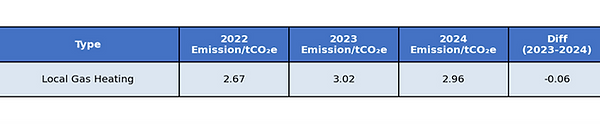
We note a decrease in emissions of 0.06 tonne. This is due to the change in conversion factors from UK Government Department for Energy Security. Consumption remains the same and if 2023 conversions were applied emissions would be constant.
Scope 2 Emissions
Scope 2 emissions have a smaller number of contributing factors than scopes 1 and 3, and as a result, is a more straightforward section to review. The sole emission source for Cosmetic Consulting Company for scope 2 was electricity usage

Electricity consumption and associated emissions remain consistent with the prior year at 1.17 tCO₂e. Consumption remains the same and if 2023 conversions were applied emissions would be constant.
Scope 3 Emissions
Scope 3 includes all other indirect emissions that occur in an organisation's upstream and downstream activities. This is where the majority of CCC's carbon emissions are produced. To identify the carbon emission, we must first determine the life cycle of our products.

We recognise the fact that not all our finished goods are returned to us by the end consumer – this may be due to the product still being in use (the product has a shelf life of 24 months once opened) or the end user has decided to dispose of the cap rather than return to CCC.
The scope of the three breakdowns can be categorised below.
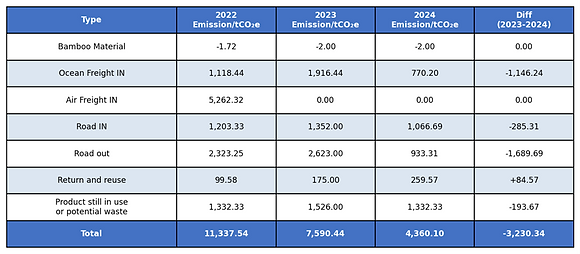
78% of all CCC scope 3 emissions relate to freight.

Discussion and Emission reduction
Scope 1
Gas Heating related to 2.96 tco2e of scope one emissions. It is possible to reduce these emissions by installing electric heating, though this would only result in a net decrease with a 100% renewable certified energy tariff. This would mean that your energy is provided by renewable options only, instead of fossil sources, thus reducing the carbon burden.
Scope 2
CCC scope 2 emissions arise from electricity consumption. As cutting consumption is frequently an unreasonable demand, a logical solution is to use a multipronged method to lower the emission value. Solar panels can have an impact. If CCC’s electricity was used to supply using solar energy this would reduce the emission burden by 1.17to2e.
Scope 3
CCC scope 3 emissions are largely generated from freight. Ocean freight has reduced significantly from 1,916 tco2e in 2023 to 770 tco2e in 2024, a reduction of 1,146 tco2e. The use of EV road vehicles would have the possibility of reducing a further 2,000 tco2e.
Using Bamboo as material instead of plastic has resulted in a beneficial 55.18 tco2e.

Roadmap to Net Zero
Total carbon emissions for CCC for the year ending 31st December 2024 was 4,360 tCO2e. As we already established the majority of the carbon emission is due to freight and a change in the way goods are being moved. To that extent CCC wil make the following changes as part of the
Roadmap to net zero:
-
All Freight in to be freighted by rail instead of road – saving 1,058 tCo2e
-
All Freight out to be freighted by rail instead of road – saving 2,095 tCo2e (cumulative total: 1,058 tCO2e)
-
Increase return and reuse from 16% to 26% saving 666 tCo2e (2024 return and reuse: 259.57 tCO2e)
-
To reduce the remaining amount CCC will carbon offset
Offseting can be purchases using the gold standard projects such as:

Conclusion
.In Conclusion, Cosmetic Consulting Company has followed their roadmap to net zero and have successfully reduced their carbon footprint by 43% or 3,234 tCo2e from 2023 to end of 2024.

As at the end of 2024 Cosmetic Consulting Company has total emissions of 4,364 tC02e which can be broken down by scope.

Scope 1 emissions have decreased slightly year on year due to revised government conversion factors, whilst scope 2 remains constant. Usage in both cases has remained unchanged.
Multiple carbon reduction options have been explored, with the emission reductions for implementing these calculated and applied to CCC roadmap to net zero. It is envisioned that implementing some or all of these options, CCC can significantly reduce their annual emissions.